Structures
What is this unit about?
Before looking at each part, take a look at the whole map. You will see how structures are organized: what they are and what types there are, the loads they carry and their stability, the forces that act on their parts and the elements and materials they are built with. Open each branch (+) to see its ideas.
STRUCTURES
A set of elements that carries loads and gives shape and support to an object or a building without breaking or tipping over.
1 · What is a structure and what types are there?
What they are for and how they are classified
1 · What is a structure and what types are there?
What they are for and how they are classified
Every structure carries loads and keeps its shape. There are natural ones (a skeleton, a tree) and man-made ones (a bridge, a building), and they are classified by their shape: solid, vaulted, frame, triangulated and suspension.
Natural
Skeleton, tree, spider web
Man-made
Bridge, building, crane, the Eiffel Tower
Frame
Columns and beams (buildings)
Triangulated
Bars in triangles (trusses, cranes)
Suspension
Cables that hold it up (suspension bridges)
Shell and geodesic
⊕ Thin shells and domes (tanks, stadiums)
2 · Loads and stability
The forces it carries and why it does not fall down
2 · Loads and stability
The forces it carries and why it does not fall down
Loads are the forces a structure carries: permanent (its own weight) or variable (wind, snow, people, vehicles). A structure is stable when it does not tip over: a wide base and a low center of gravity help.
Permanent loads
Its own weight (does not change)
Variable loads
Wind, snow, people, vehicles
Stability
It does not tip over: wide base and low weight
Center of gravity
The lower it is, the more stable
3 · Forces on the parts
How the parts "suffer" when there are loads
🎮
3 · Forces on the parts
How the parts "suffer" when there are loads
When a structure carries loads, its parts work in tension (they are stretched), compression (they are squashed), bending (they are bent), torsion (they are twisted) or shear (they are cut).
Tension
Stretch: tie rod, cable
Compression
Squash: column, chair leg
Bending
Bend: shelf, beam
Torsion
Twist: a key, a shaft
Shear
Cut: scissors, rivet
4 · Elements and materials
The parts of a structure and what they are made of
🎮 ⊕
4 · Elements and materials
The parts of a structure and what they are made of
A frame structure has foundations (support in the ground), vertical supports (columns) and horizontal supports (beams), as well as arches and trusses. Triangulation makes it rigid. It is built with wood, concrete, reinforced concrete and steel.
Foundations
Footings, slabs, piles
Vertical support
Columns, pillars, tie rods
Horizontal support
Beams, joists, floor slab
Arch and vault
They span gaps by curving
Triangulation / truss
The triangle is rigid
Materials
Wood, concrete, reinforced concrete, steel
Sections and calculation
⊕ Sections (I-beam, tube), moments and reactions
🎯 What you are going to learn
How to recognize the types of structure, identify the forces and the elements, understand why triangulation gives rigidity, and apply it by building a bridge in the "Bridge League". The branch with 🎮 has a simulator; the ones marked ⊕ are the extension for ages 14-15.
What is a structure?
A bridge carries the weight of hundreds of cars, a building stays standing in wind and rain, and your own skeleton holds you up. They are all structures: what makes things not break and not fall down.
A structure is a set of elements joined together whose job is to carry the loads (the forces acting on it) and keep its shape without breaking or tipping over. It usually also supports and protects an object or a building.
Natural and man-made structures
We humans did not invent structures: nature has been making them for millions of years. There are two big groups:
They are made by nature, with no human involvement.
A skeleton, the trunk and branches of a tree, a spider web, a honeycomb, a shell.
They are built by people for a purpose.
A bridge, a building, a crane, a tower, a chair, the Eiffel Tower.
Types by shape
Depending on how they are made and how they carry loads, structures are classified into several types:
Solid
A lot of solid material; it holds up because of its weight. E.g.: a dam, a city wall, a pyramid.
Vaulted
It uses arches and vaults to span gaps. E.g.: an aqueduct, a cathedral.
Frame
A grid of columns and beams. It is the one used in modern buildings.
Triangulated
Bars forming triangles (trusses). E.g.: a crane, a power line tower.
Suspension
It is held up by tight cables. E.g.: a suspension bridge.
Shell and geodesic ⊕
Thin curved shells or domes made of triangles. E.g.: a tank, a covered stadium.
Every structure has the same job: to carry loads without breaking or tipping over. What changes is how it does it (with mass, with arches, with triangulated bars or with cables).
Practice: 5 questions
Tap the right answer. Instant feedback.
1. What is a structure?
2. Which of these is a natural structure?
3. A building made with columns and beams is a structure that is…
4. Which type of structure is held up by tight cables?
5. A concrete dam holds back the push of the water mainly because…
Loads and stability
A shelf full of books sags, the wind pushes a crane, snow piles up on a roof… All of those are loads that the structure has to carry without breaking and without tipping over.
A load is any force acting on a structure that the structure has to withstand: its own weight, what it holds up, the wind, the snow, people… Designing a structure well means making sure it can carry all its loads.
Permanent loads and variable loads
Depending on whether they change over time or not, loads are divided into two types:
They do not change over time: they are always there.
The own weight of the structure, the weight of a roof, of a wall.
They change over time: they come and go.
The wind, the snow, people, the vehicles on a bridge.
Stability: not tipping over
As well as not breaking, a structure has to be stable: it must not tip over (fall sideways) under the loads. Two things make it more stable: a wide base and a low center of gravity (the weight spread low down).
A structure is more stable the wider its base and the lower its center of gravity. That is why a pyramid almost never tips over and a tall, thin streetlight has to be firmly anchored to the ground.
Practice: 5 questions
Tap the right answer. Instant feedback.
1. What is a load?
2. The own weight of a bridge is a load that is…
3. The wind pushing a building is a load that is…
4. When is a structure more stable?
5. A tall, narrow glass tips over more easily than a short, wide one because…
Forces on the parts
When you sit on a chair, its legs get squashed; if you hang from a bar, it gets stretched; if you bend a ruler, it curves. Each part of a structure "suffers" in a different way depending on how the forces reach it: that is the type of force it is under.
The type of force on a part is the way it resists, inside, the loads it receives. There are five: tension, compression, bending, torsion and shear.
The five types of force
Tension
The forces stretch the part (they pull its ends outwards). E.g.: a cable, a tie rod, the rope of a swing.
Compression
The forces squash the part (they press it). E.g.: a column, the leg of a chair, a pillar.
Bending
The forces bend the part. E.g.: a shelf with books on it, a beam, a diving board.
Torsion
The forces twist the part (they turn it in opposite directions). E.g.: a key, a screwdriver, a shaft.
Shear
Two forces very close together in opposite directions cut the part. E.g.: scissors, a rivet, a hook in the wall.
In bar structures (like a truss bridge), the two forces that matter most are tension (red 🔴) and compression (blue 🔵). In the simulator you will see each bar in that color depending on how it is working.
Try it in the lab
Open the simulator in free mode, build a simple structure, apply a load and watch which bars turn red (tension) and which turn blue (compression).
Practice: 5 questions
Identify the type of force in each case. Instant feedback.
1. The cable a lamp hangs from is in…
2. The leg of a chair you sit on is in…
3. A shelf full of books sags in the middle. It is under…
4. When you turn a key in the lock, its body is under…
5. When scissors cut paper, the force they apply is…
Elements and triangulation
A building stands on a "skeleton" of columns and beams resting on the ground. And a crane or a bridge does not bend out of shape thanks to a brilliant trick: they are full of triangles. Let's look at the parts of a structure and why the triangle is so important.
A frame structure is a grid of vertical supports (columns) and horizontal supports (beams) resting on foundations that spread the weight into the ground. It is the structure of today's buildings.
The parts of a frame structure
Foundations
They rest the structure on the ground and spread the weight. Types: footings, slabs and piles.
Vertical supports
They carry the weight down to the foundations: columns, pillars, lintels and tie rods.
Horizontal supports
They hold up the loads and the floors: beams, joists and the floor slab (the floor of each story).
Arch and vault
They span gaps by curving and work in compression. E.g.: aqueducts, stone bridges.
Types of foundation
Foundations spread the weight into the ground in three ways, depending on what the ground is like:
Footing
A wide block of concrete under each column. The most common.
Slab
A big concrete platform under the whole building. For soft ground.
Piles
Columns driven very deep down to firm ground.
Vertical supports
They bring the weight of the structure down to the foundations. The main ones are:
Column (square)
A vertical support with a square or rectangular cross-section. The most common in buildings.
Column (round)
A column with a circular cross-section, classic in temples and façades (the Parthenon).
Lintel
A beam that closes the opening of a door or window, resting on two supports.
Tie rod / tensioner
A bar or cable that works in tension and braces the structure (gives it stability).
Horizontal supports
They hold up the loads and the floors, spreading them towards the columns:
Beam
The main horizontal element; it spans the distance between two columns.
Joist
Small, repeated beams that spread the load of the floor.
Floor slab
The floor of each story: joists + filler blocks + a layer of concrete.
Arch and vault
They span gaps by curving, so that the material works in compression (its strong point):
Arch
A curve that spans the gap between two supports. E.g.: the Aqueduct of Segovia.
Vault
An arch extended in depth; it covers a long space (a tunnel, a nave).
Dome
A vault rotated around its axis; it covers a round space (a cathedral).
The supports (columns and beams) are usually made of reinforced concrete, steel or wood; arches and vaults, of stone, brick or concrete. You will see the materials in depth in Lesson 5.
Famous structures: spot their elements
Look at these famous buildings and notice which structural element stands out in each one:
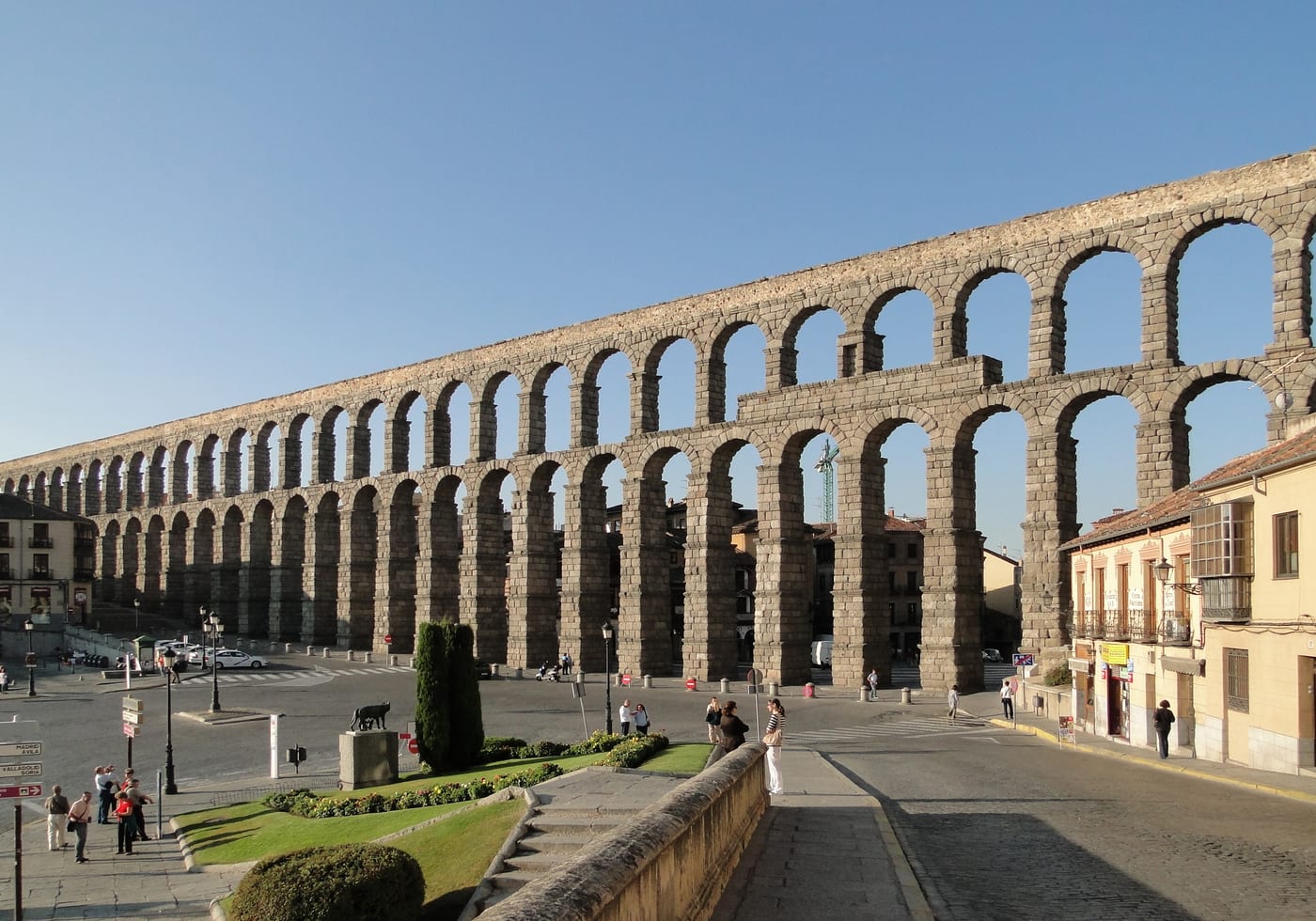
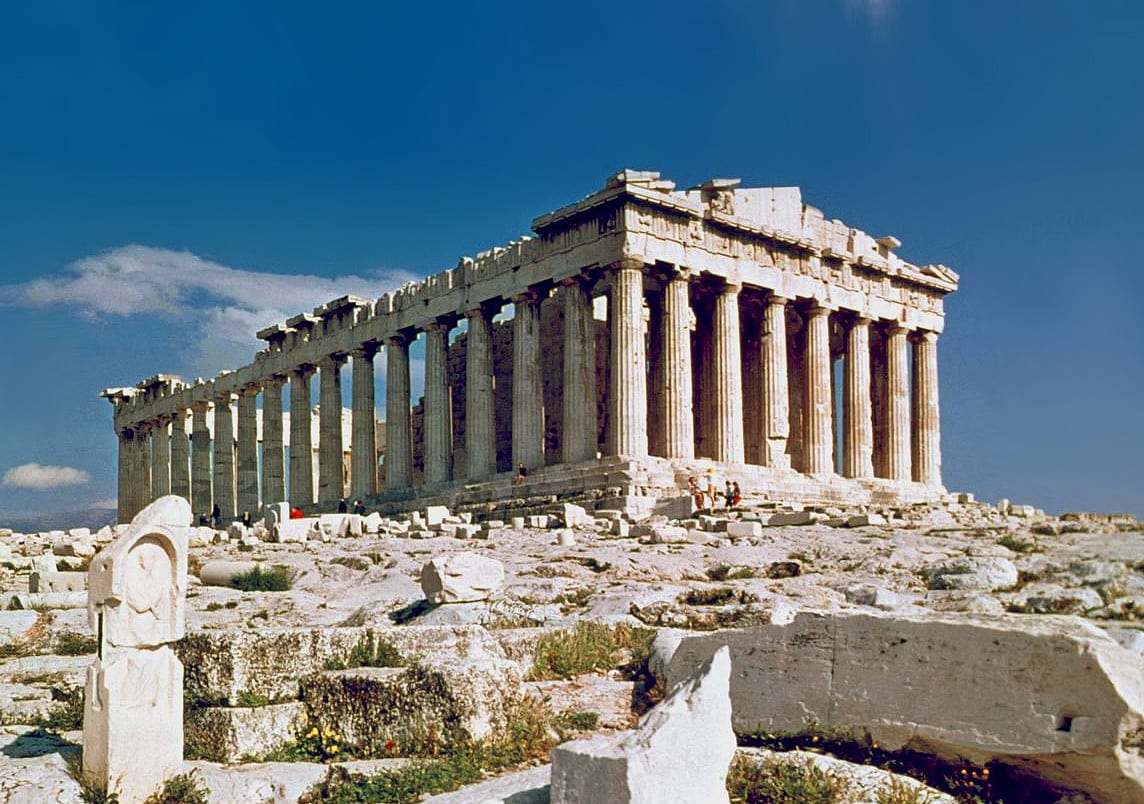
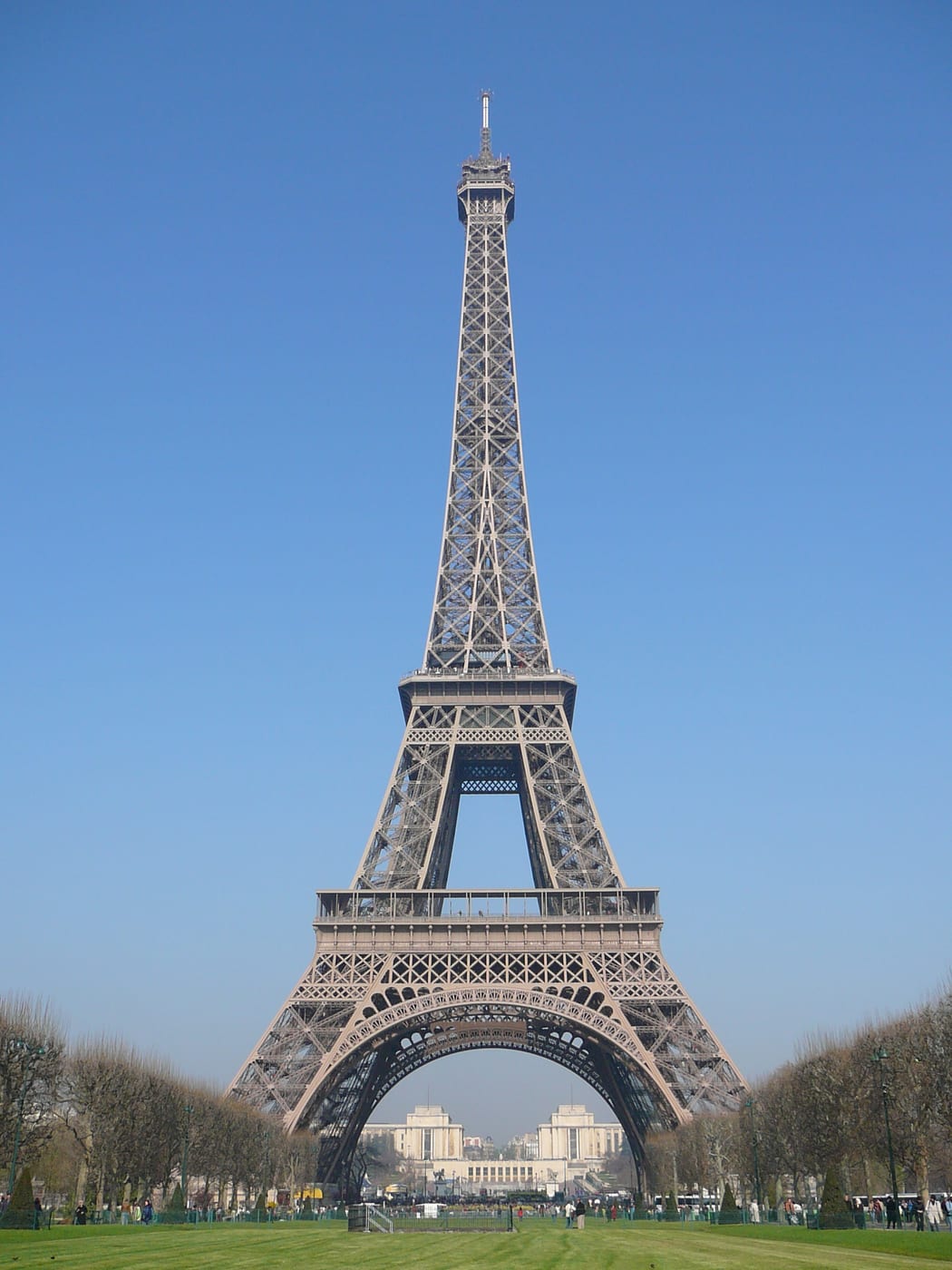
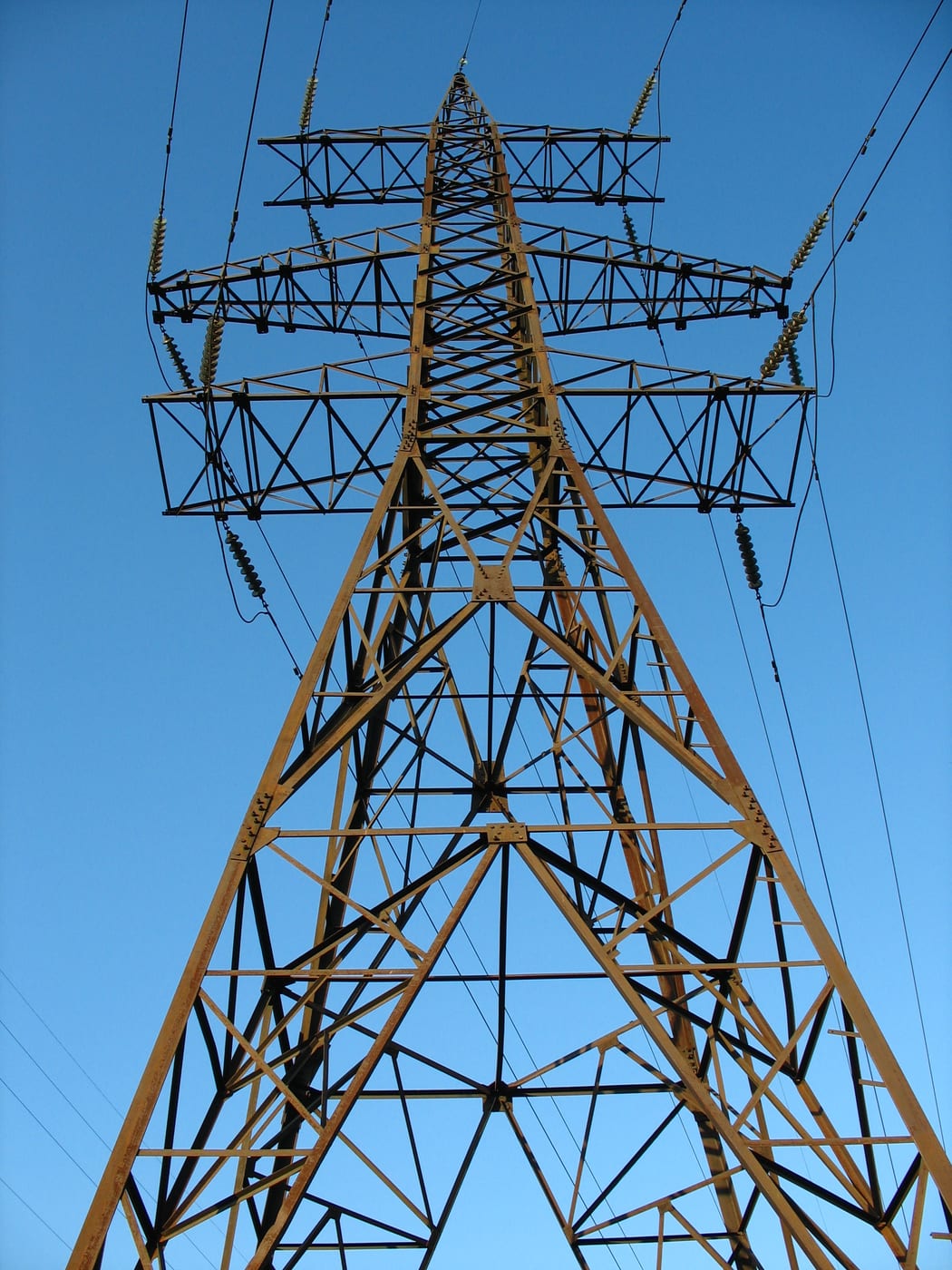
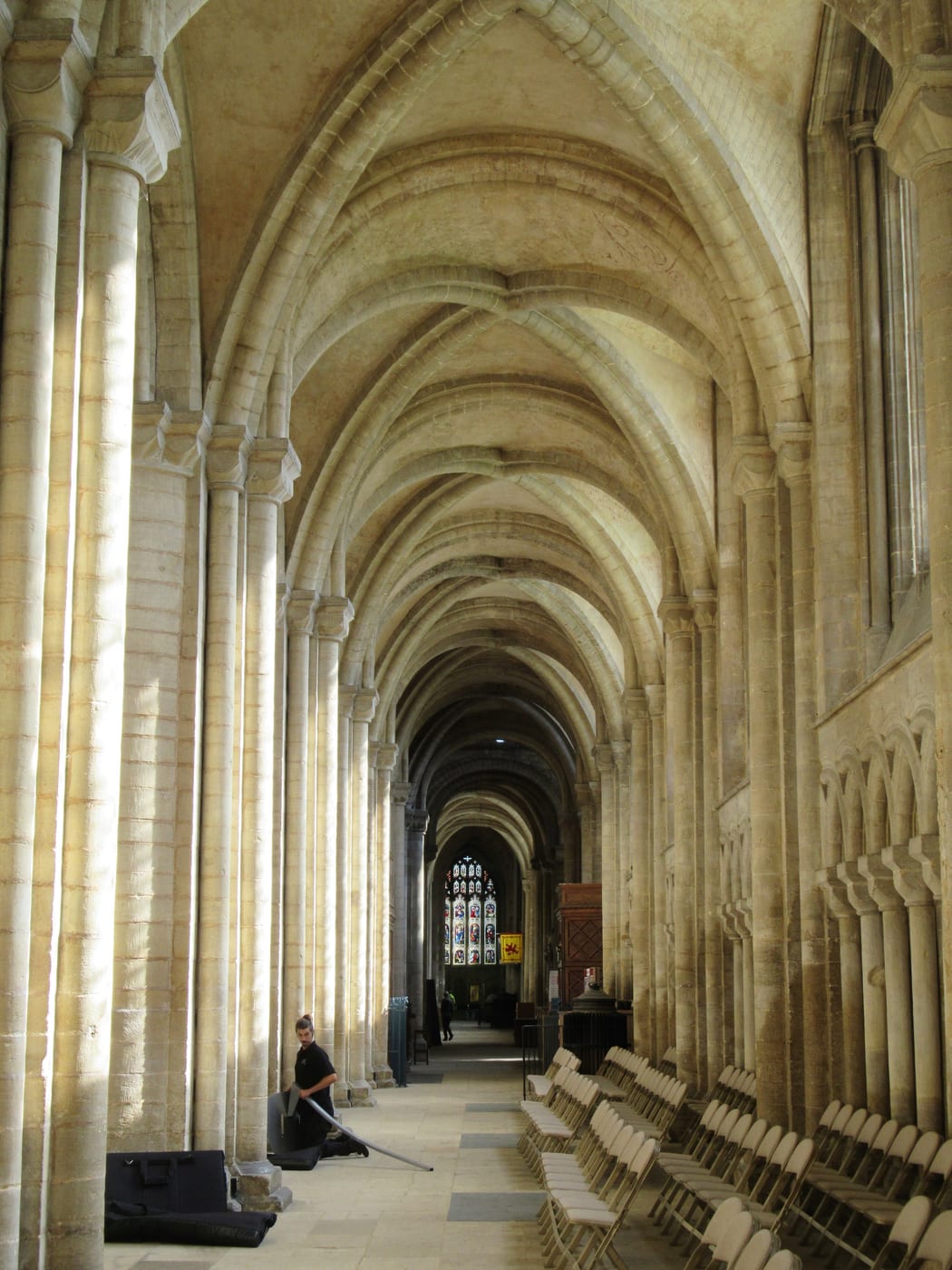
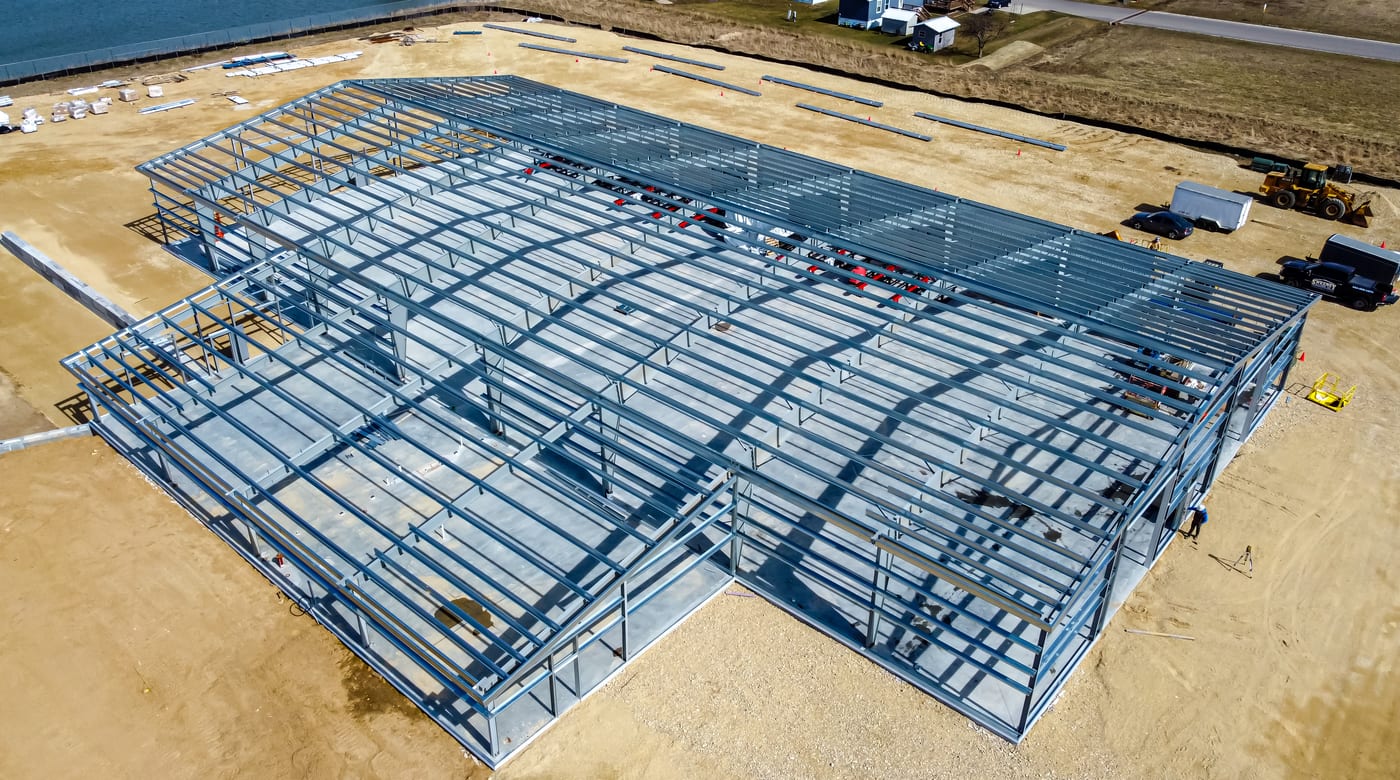
Photos: Wikimedia Commons (free licenses).
Triangulation: the secret of rigidity
If you make a square out of bars joined at the corners, it bends out of shape and collapses when you push it (it turns into a rhombus). A triangle, on the other hand, cannot change shape: it cannot change shape unless one of its sides breaks or stretches. That is why, to make a structure rigid, we fill it with triangles: this is called triangulating.
Look at the joints (the circles): in the square they can rotate, so the shape collapses into a rhombus. In the triangle there is no way to move them without stretching or breaking a side → it cannot change shape. When you add a diagonal, the square is split into two triangles and no longer moves.
The triangle is the only shape that cannot be deformed. When you see a crane, a power line tower, a roof truss or a metal bridge, look closely: they are full of triangles. That is triangulation, and it is what gives them rigidity without using much material.
Try it: make the square stable
Open the simulator in triangulation mode: you will see a square that collapses. Add a diagonal (join two opposite corners) and watch how it starts to hold.
Practice: 5 questions
Tap the right answer. Instant feedback.
1. The part that rests the structure on the ground and spreads the weight is…
2. The vertical elements that carry the weight down to the foundations are…
3. The horizontal elements that hold up the floors and the loads are…
4. Why is a triangle of bars rigid and a square is not?
5. To stop a square bar structure from deforming, the simplest thing is to…
▸ Spot the element in famous structures
6. The Aqueduct of Segovia stays standing thanks to its…
7. The Eiffel Tower is rigid and light at the same time because it is made of thousands of…
8. The columns of the Parthenon work as supports that are…
Materials + ⊕ extension for ages 14-15
The same structure is not built the same way in wood as in steel. Choosing the right material is part of the design: it has to withstand the forces, last and not cost too much.
Structural materials
These are the materials most used in building and what they are good for:
Wood
Light, easy to work and renewable. Traditional in roofs and houses.
Concrete
A mixture of cement, sand, gravel and water. It withstands compression very well… but tension badly.
Reinforced concrete
Concrete with steel bars inside. The best of both! It is the star material of buildings.
Steel
Very strong in tension and compression, and fairly light. Skyscrapers, bridges, cranes.
Reinforced concrete is a brilliant trick: concrete withstands compression 🔵 wonderfully but cracks in tension 🔴; steel withstands tension very well. By putting steel bars inside the concrete, each one does what it does best. That is why it is used so much!
Materials: 3 questions
Tap the right answer. Instant feedback.
1. Which material combines concrete (strong in compression) and steel (strong in tension)?
2. The very strong and fairly light material used in skyscrapers, cranes and bridges is…
3. Plain concrete (without steel) withstands very well…
Calculating: moments and reactions
At ages 14-15 we go a step further and do the numbers. Two key ideas: the moment of a force and the reactions at the supports.
The moment of a force (M = F · d)
A force acting at a certain distance from a pivot produces a moment (a turning effect). It is the law of the lever applied to structures: the further from the pivot, the more turning effect the same force produces.
The seesaw is balanced when the moments on each side are equal: F₁ · d₁ = F₂ · d₂.
Reactions and forces, step by step
The supports push up to hold the structure: these are the reactions. To work them out we use the fact that the structure is in equilibrium: it does not move or rotate. That gives us three conditions — ΣFy = 0 (vertical forces), ΣFx = 0 (horizontal ones) and ΣM = 0 (turning). Let's solve this structure from the simulator, with a 12 N load at the top joint:
💡 Build this same structure in the structures lab (free mode): you will see the diagonals blue (compression) and the bottom bar red (tension), and when you tap a support it will give you R = 6 N. The same numbers you have calculated!
Numerical: 3 calculations
Type the result and tap Check (a small margin is allowed).
1. A force of 30 N acts 2 m from the pivot. What moment does it produce? (M = F · d)
2. On a seesaw, a child weighing 300 N sits 1 m from the pivot. How far away must another child weighing 200 N sit to balance it? (F₁·d₁ = F₂·d₂)
3. A beam supported at both ends carries 200 N in the middle. What is the reaction at each support?
Review of the whole unit
Go over the whole topic: what a structure is and its types, the forces, the elements and triangulation, stability and, at the end, some calculation. The questions marked ⊕ are the extension for ages 14-15. You get instant feedback on each one.
A1. What is a structure mainly for?
A2. A snail shell and a honeycomb are structures that are…
A3. A dome, an igloo or a bridge with stone arches hold up thanks to their curved shape. They are structures that are…
A4. The pyramids of Egypt, huge solid blocks of stone, are structures that are…
A5. A high-voltage power line tower, made of iron bars in triangles, is a structure that is…
A6. A bridge whose deck hangs from big cables (like the Golden Gate) is a bridge that is…
Look at the drawing for each case and say which type of force it shows.
B1. The arrows pull the part outwards (they stretch it). It is…
B2. The arrows press the part at its ends (they squash it). It is…
B3. The part curves downwards because of a load in the middle. It is…
B4. The two arrows turn the part in opposite directions (they twist it). It is…
B5. Two forces very close together and in opposite directions cut the part. It is…
B6. Now put it all together. On this swing, the child's weight makes each part work in a different way. Which row is correct?
C1. In a house, the ground under one corner gives way and that part of the building sinks and cracks. Which element has failed?
C2. The tie rods and tensioners of a structure (like the guy ropes holding a tent or a mast) work mainly in…
C3. Of these two shapes made of bars with joints that can rotate, which one is rigid (does not deform)?
C4. The floor of each story of a building, made of beams, joists and a layer of concrete, is called the…
C5. What do a construction crane, a power line tower and the Eiffel Tower have in common?
D1. Which of these two towers is more stable (harder to tip over)?
D2. A double-decker bus carries lots of passengers on the top deck. Compared with a single-decker, on a bend it is…
D3. A tall, narrow streetlight is made more stable by…
D4. A structure tips over when…
E1. ⊕ Moment of a force. A force of 60 N is applied 0.5 m from the pivot. What is the moment? (M = F · d)
E2. ⊕ Seesaw. On the left there are 200 N at 1.2 m from the pivot. On the right, 400 N are hung. How far from the pivot must they go to balance it? (F₁·d₁ = F₂·d₂)
E3. ⊕ Reactions (symmetrical case). A beam supported at both ends carries 500 N right in the middle. What is the reaction at each support?
E4. ⊕ Reactions (off-center load). A 4 m beam is supported at its ends A and B. A load of 800 N acts 1 m from A. What is the reaction at B? (take moments about A: RB·4 = 800·1)
E5. ⊕ In the structures lab, a bar that turns blue 🔵 is working in…
Bridge League 🌉
In teams, you are going to design and build a bridge that spans a gap (the span) between two supports and holds as much weight as possible. First you will test it in the simulator and then you will build it with craft sticks or spaghetti. The winner is the one that best combines strength and lightness.
Build a bar bridge that rests only on its two ends, spans a gap of at least 30 cm and holds the most weight in the middle without collapsing. The structure must be triangulated (made of bars, not a solid block) and weigh as little as possible.
The science behind it
A bridge holds up because it is triangulated: triangles do not deform. When it is loaded, each bar works in tension (🔴 it is stretched) or in compression (🔵 it is squashed). The more triangles and the better the forces are shared out, the more weight it holds with less material.
An example diagram
This is a simple truss bridge: a row of triangles between two supports (one pinned and one roller) with the load in the middle. It is exactly the kind of structure the simulator builds.
Design it first in the lab
Open the simulator in challenge mode: you have two supports apart and a load in the middle. Add bars until it says HOLDS, using as few bars as possible. Look at which bars turn red (tension) and which turn blue (compression).
The 4 stages of the project
Design it in the simulator
⏱ 1 session
In the structures lab (challenge mode), build a bridge that spans the gap and HOLDS the load. Write down the design that works best for you.
Hand in: a diagram of the bridge (by hand or a screenshot of the simulator).
Build it
⏱ 1-2 sessions
Build the bridge with craft sticks or spaghetti and glue, copying your design. Triangulate it well and let the joints dry.
Hand in: the finished bridge, weighed (its own weight in grams).
Load test
⏱ ½ session
Rest the bridge only on its ends and hang or stack weight in the middle little by little until it fails. Write down the maximum weight it held.
Hand in: the weight it held (grams) and a photo/video of the test.
The League
⏱ ½ session
Compare the results of the class. The winner is the one with the best efficiency = weight held ÷ weight of the bridge (not the beefiest, the smartest!).
Hand in: the ranking + an explanation of why it held.
Materials per team
The bars of the bridge. Straws or wooden skewers also work.
For the joints. Hot glue dries faster (careful, it burns).
To mark the span and rest the bridge only on its ends.
To hang the weight from the middle in the load test.
The weight for the test. It is added little by little.
To cut the bars to size and hold them while the glue dries.
League rules
- The bridge rests only on its two ends and must span a gap of at least 30 cm.
- It has to be a structure of triangulated bars: no solid blocks and no filling it with glue.
- Its own weight counts: the best efficiency wins (weight held ÷ weight of the bridge), not the heaviest.
- The load is added little by little in the middle. The last weight it held without collapsing is written down.
- Be careful with hot glue and scissors: safety first.
How the project is graded
The grade comes from 5 criteria:
Tips to make it hold
Triangulate everything
Every square gap deforms: add a diagonal and turn it into two triangles.
Strong joints
A bridge almost always fails at a joint that comes unstuck. Glue well and let it dry completely.
Light but strong
Do not add bars "just in case": every extra gram lowers your efficiency. Remove whatever is not working.
Test little by little
Add weight slowly and watch which bar bends first: that is your weak point.
⊕ Extension (ages 14-15): predict before you build
If you want to go further, be the structural engineer before building anything:
Predict tension and compression
Look at your design and write down which bars you think will be in tension (🔴) and which in compression (🔵). Then open it in the simulator and check: did you get it right?
Work out the reactions
If the load is right in the middle and the two supports are the same, each support holds half the weight. Check it by tapping the supports in the simulator (Rx/Ry).
🌉 Time to build! The aim is not just that it holds — it is to understand why: the triangulation that gives rigidity and the bars working in tension and compression that you have seen in the unit.